
Go over ten mythical and historical reasons why Diwali (Deepavali) is celebrated annually.
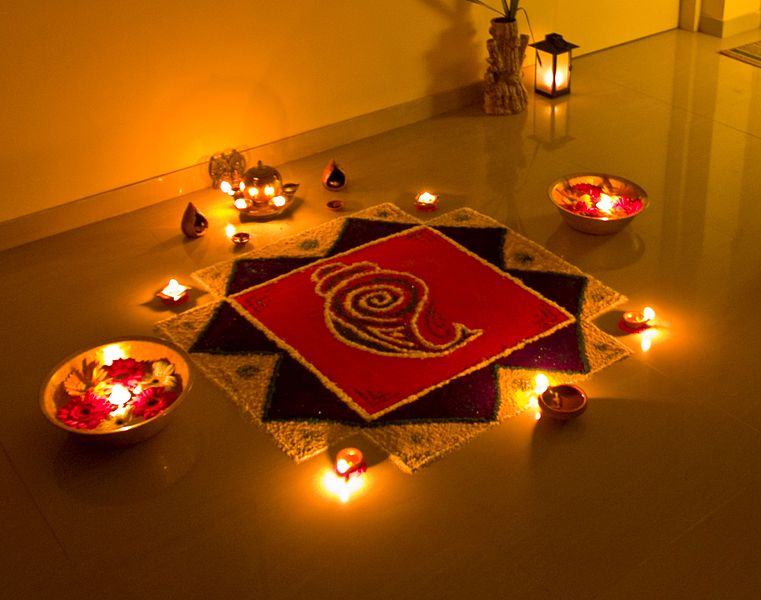
1) Goddess Lakshmi’s Birthday :
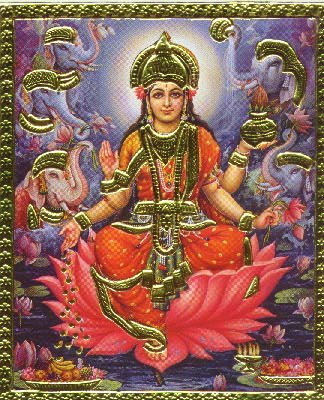
On
this very Diwali day, the Goddess of wealth, Lakshmi is said to have
been incarnated from the depth of the bottomless ocean. The Hindu
scriptures tell us that both Devas(gods) and Asuras (demons) were mortal
(Mrita) at one point of time. Seeking a deathless condition
(Amarattva), they churned the ocean to seek Amrita, the nectar of
immortality (an event
mentioned in the Hindu scriptures as “Samudra-manthan”), during which a
host of divine celestial objects came up. Prime among these was Goddess
Lakshmi, the daughter of the king of the milky ocean, who arose on the
new moon day (amaavasyaa) of the Kartik month. She was subsequently
married to Lord Vishnu on the same darkest night of the year and
brilliant lamps were illuminated and placed in rows to mark this holy
occassion.
Hence the association of Diwali with Goddess Lakshmi
and the tradition of lighting of lamps and candles during the festival.
To this day, Hindus celebrate the birth of the goddess Lakshmi and her marriage to Lord Vishnu on Diwali and seek her blessings for the coming year.
2) The Legend of King Mahabali :
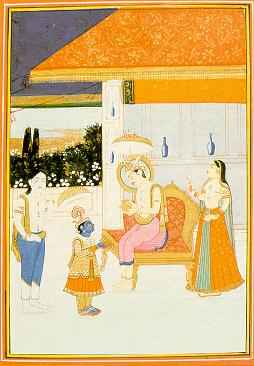
The
Bhagavata Purana
(also known as Srimad Bhagavatam), the most sacred Hindu text, reveals
how on a Diwali day Lord Vishnu, in his fifth incarnation as
Vaman-avtaara, rescued Lakshmi from the prison of King Bali
during the Treta Yug. Bali, or rather King Mahabali, was a powerful
demon king who ruled the earth. Powered by a boon granted to him by Lord
Brahma, Bali was invincible and even gods failed to defeat him in
battles. Although a wise and perfect king otherwise, Mahabali was
violent in his ways with the Devas (gods). On their insistence, Lord
Vishnu disguised himself as a short Brahmin and approached Bali for some
charity. The righteous and benevolent King couldn’t refuse the
Brahmin’s offer and was tricked into giving up his kingship and wealth
(of which Lakshmi is said to be the Goddess). Diwali marks this
overcoming of Mahabali by Lord Vishnu and this is another reason why
Goddess Lakshmi is worshipped on Diwali.
In Kerala, the festival of ‘Onam’ is
celebrated around the month of August to mark this legend.
3) The Killing of Narakasura:
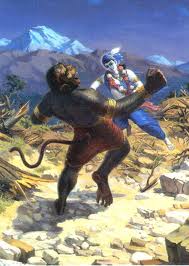
The Bhagavata Purana tells us about Narakasura, an evil demon king who had managed to
acquire awesome powers. Unrivalled in prowess, he conquered both the
heavens and earth and was tyrannical in his reign. Addicted to power, he
even stole the earrings of Aditi, the heavenly mother goddess, and
usurped some of her territory. When Lord Vishnu was incarnated as
Krishna in the Dwapara Yuga, he killed Narakasura on the day preceding
Diwali and rescued 16,000 women whom the demon had imprisoned in his
palace. The deliverance from the terrible Narakasura was celebrated with
much grandeur, a tradition that continues to this day.
However,
another version of the story credits Lord Krishna’s wife Sathyabhama as
the one who eliminated
Narakasura. It is said that Narakasura could only be killed by his
mother Bhudevi and as Satyabhama was an incarnation of the same Bhudevi,
she only could kill him. Before death, however, Narakasura realized his
mistake and requested a boon from Satyabhama that everyone should
celebrate his death with colorful light. To commemorate his death, the event is celebrated in some parts of India as Naraka Chaturdasi, two days before Diwali day.
4) The Return of the Pandavas:
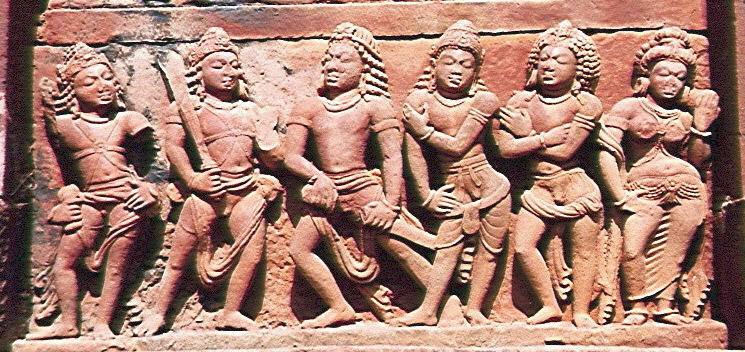
The great Hindu epic `Mahabharata’ reveals that it was `Kartik
Amavashya’ (the new moon day of the Kartik month) when the Pandavas
appeared from their 12 years of banishment as a result of their defeat
in the hands of the Kauravas at the
game of dice (gambling). The five Pandava brothers, their mother and
their wife Draupadi were honest, kind, gentle and caring in their ways
and were loved by all their subjects.
To celebrate the joyous occassion of their return to Hastinapura and to
welcome back the Pandavas, the common people illuminated their state by
lighting bright earthen lamps everywhere. And the tradition is
maintained to this day.
5) The Victory of Rama:
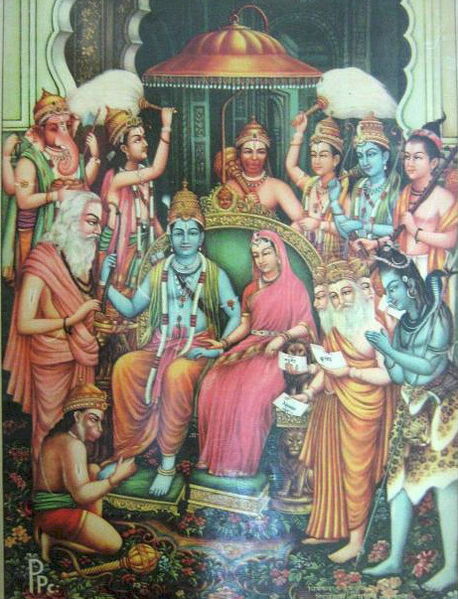
The great Hindu epic `Ramayana’ describes how Lord Ram (the incarnation
of Lord Vishnu in the Treta Yug) conquered Lanka after vanquishing the
evil King Ravana and after passing a period of of fourteen years in
exile returned to his capital Ayodhya
on a new moon day of Kartik with wife Sita and brother Lakshman. To
celebrate the homecoming of their beloved king, the people of Ayodhya
burst crackers,
lit up their houses with earthen lamps (diyas), and decorated the
entire city in the grandest manner. Year after year this homecoming of
Lord Rama is commemorated on Diwali with lights, fireworks, bursting of
crackers and merriment. The festival gets its name Deepawali, or Diwali,
from the rows (avali) of lamps (deepa) that the people of Ayodhya lit
to welcome their King.
6) Coronation of Vikramaditya:
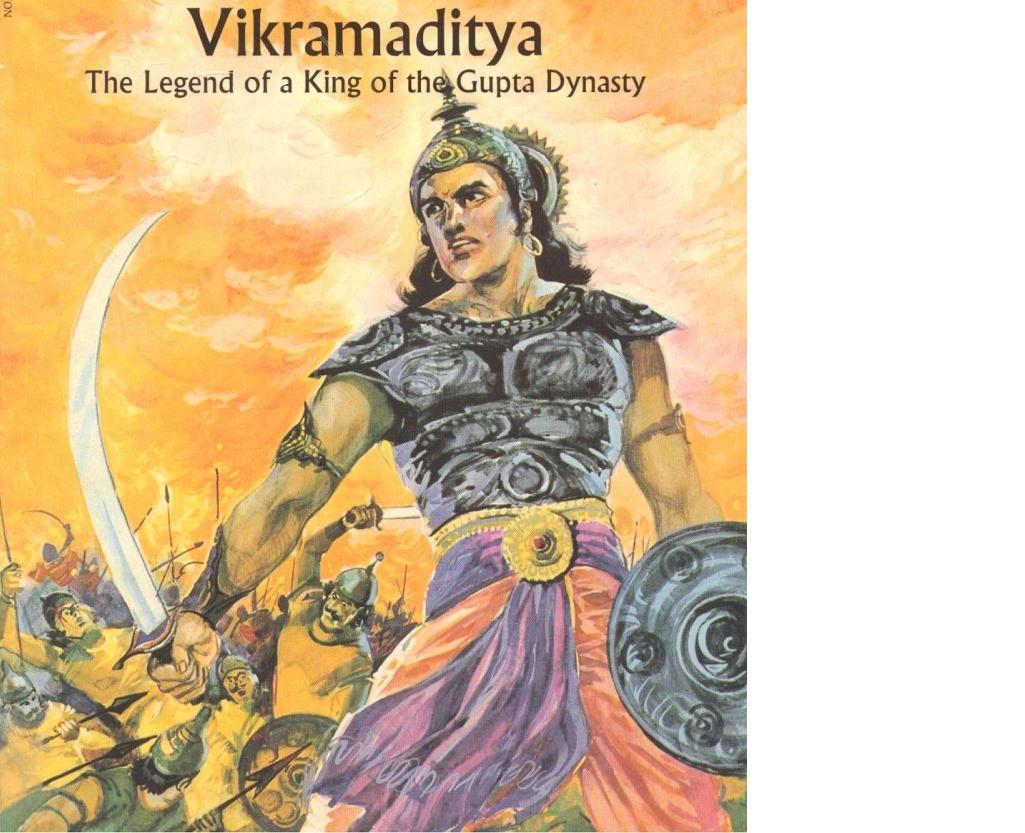
It is also said that Vikramaditya, the legendary Indian king famed for
his wisdom, valour and magnanimity was coroneted on the Diwali day
following his victory over the Sakas in 56 BC. This was marked by a
grand celebration which is still maintained annually. One of the
greatest Hindu monarchs, Vikramaditya ruled the greatest empire
in the world from modern-day Thailand in the east to the borders of modern-day Saudi Arabia in the west. Diwali, thus, apart from being a religious festival also has a historical association.
7) The Enlightenment of Swami Dayananda Saraswati:
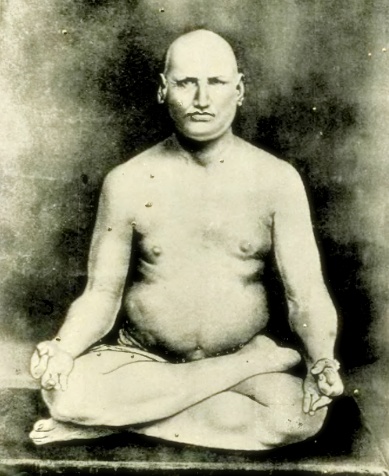
Diwali also marks the auspicious occasion when on a new moon day of
Kartik (Diwali day) Swami Dayananda Saraswati, one of the greatest
reformers of Hinduism
attained his nirvana (enlightenment) and became Maharshi Dayananda,
meaning the great sage Dayananda. In 1875, Maharshi Dayananda founded
the Arya Samaj, “Society of Nobles”, a Hindu reform movement to purify Hinduism of the many evils it became associated with at that era. Every Diwali, this great
reformer is remembered by Hindus all over India.
8) The Enlightenment of Vardhamana Mahavira:
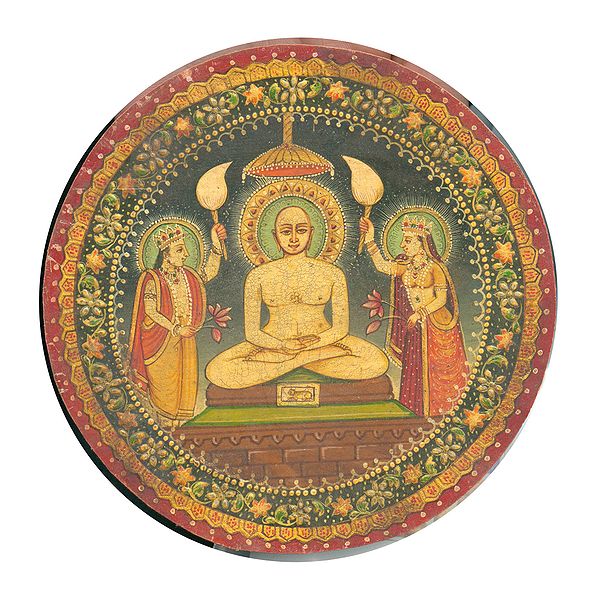
For Jains, Diwali commemorates the enlightenment of Vardhamana
Mahavira(the twenty-fourth and last Tirthankaras of the Jains and the
founder of modern Jainism) which is said to have occurred on Oct. 15,
527 B.C.
This is one more reason to engage in Diwali celebrations for pious
Jains and other than the purpose of commemoration, the festival stands
for the celebration of the emanicipation of human spirit from earthly desires.
9) Special Day for the Sikhs:
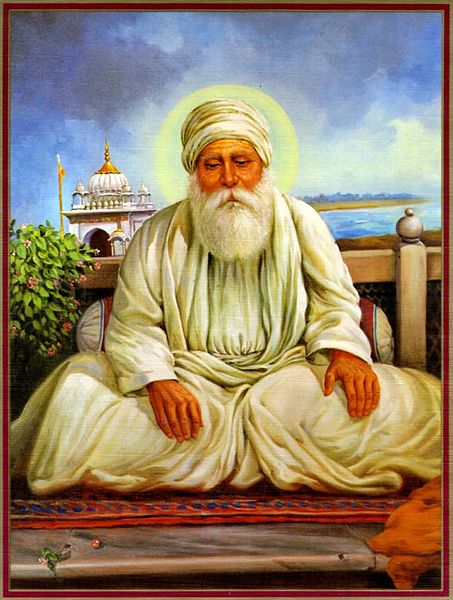
For Sikhs, Diwali holds a special significance for it was on a Diwali
day that the third Sikh Guru Amar Das institutionalized the festival of
lights as an occasion when all Sikhs would gather to receive the Gurus
blessings. It
was also on a Diwali day in 1619 that their sixth religious leader,
Guru Hargobind Ji, who was held by the Mughal Emperor Jahengir in the
Gwalior fort, was freed from imprisonment along with 52 Hindu Kings
(political prisoners) whom he had arranged to be released as well. And
it was also on the same auspicious occasion of Diwali when the
foundation stone of the Golden Temple at Amritsar was laid in 1577.
10. Goddess Kali:
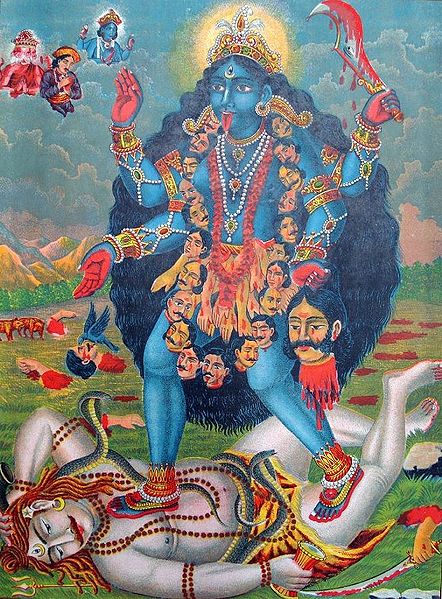
Kali, also called Shyama Kali, is the first of the 10 avatars
(incarnations) of Goddess Durga, Lord Shiva’s consort. According to
legend, long ago after the gods lost in a battle with the demons,
Goddess Kali was born as Kal Bhoi Nashini from the forehead of Goddess
Durga. Said to be a personification of Nari Shakti
(female power), Kali was born to save heaven and earth from the growing
cruelty of the demons. After killing all the devils, Kali lost her
control and started killing anyone who came her way which stopped only
when Lord Shiva intervened. The well-known picture of Ma Kali, with her
tongue hanging out, actually depicts the moment when she steps on the
Lord and repents.
That momentous day has been commemorated ever
since and the main purpose of celebrating Kali Puja is to seek the help
of the goddess in destroying evil both external and internal to us as
also to get her blessings for general happiness, health, wealth, and
peace.
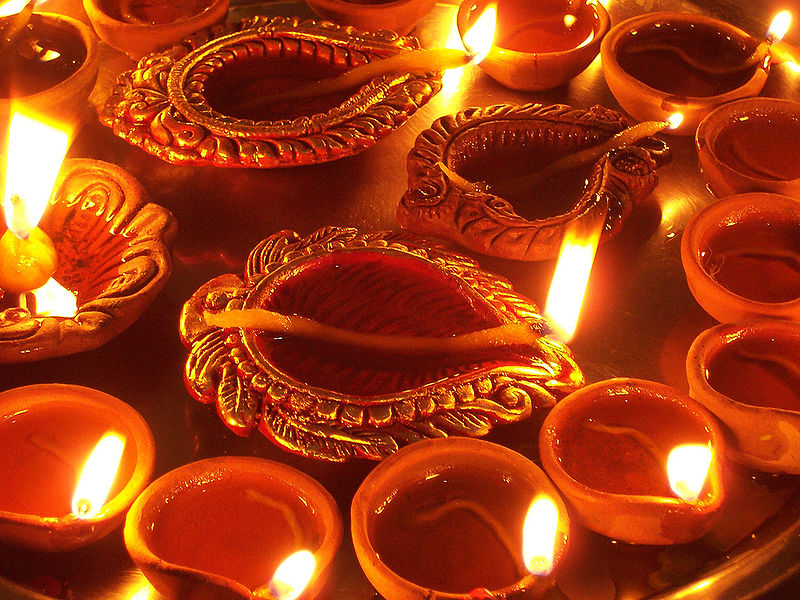
To conclude, there are several reasons behind Diwali
celebrations and almost every region of India has its own reason to
observe the occasion. All of these however, matters little to the
festival itself. Whatever the cause behind its celebration, Diwali is
undoubtedly a national festival of India, and the
aesthetic aspect of the festival is enjoyed by most Indians regardless
of faith.
reference: From a mail written by Rahul (bruntno1@yahoo.com) from gayatri parivar .
 TheIntRendz